Martha Grimes writes the Richard Jury detective novels, which regularly see its charismatic Scotland Yard detective sort out a complicated murder mystery, the plotting of which would have done Agatha Christie proud (high praise from me indeed!), aided by his good friend, the reluctant peer Melrose Plant, and set around a quaint English hostelry which also lends its name to the title. Somewhere in the mix there is often an intelligent and quirky kid.
When Grimes decided to write Hotel Paradise, she began a series of novels where the kid is the sleuth, in this case the quirky and intelligent Emma Graham. Emma is twelve, and lives in an old hotel at Spirit Lake, once the site of several hotels that have long since closed up shop, as holiday makers found other, brighter spots to visit instead.
The Hotel Paradise is still hanging in there, with Emma's mother running the kitchen, her wonderful cooking its main attraction. Her business partner manages drinks and accounts, but mostly drinks, while her ditzy daughter swans around as if she owns the place, much to the disgust of Emma's great aunt Aurora Paradise.
Aunt Paradise lives on the top floor, drinking cocktails and reliving the past, which comes in handy when Emma begins to look into a forty-year-old tragedy, the drowning of another twelve year old girl, Mary-Evelyn Devereau. Brought up by aunts, it has long been a mystery why Mary-Evelyn took a leaky boat out onto the lake one evening, her disappearance not noticed or ignored until it was too late.
Emma is similarly ignored by her own family, her mother too busy with the hotel, her brother and his pal writing and performing plays, so that apart from her regular stints waiting tables, she has a lot of free time. No one knows what she gets up to or where she goes, which is convenient for investigating a possible murder. Her friendship with the local police chief, the handsome, dependable Sheriff DeGheyn also comes in handy as well as her talent for cultivating friendships with older people. When another mysterious death occurs which is connected to Mary Evelyn's family, it seems even more likely that Emma is on to something.
Emma is a wonderful narrator, who never gives up, telling the most outrageous porkies to worm out the information she needs. She is so solitary, and put-upon at home, she has the reader's sympathy in spades - it just well people around town look out for her.
Grimes has created some terrific small town characters, too: the speech impaired brothers, Ubub and Ulub, and their fellow bench mate Mr Root, who is always happy to translate. There's Maud at the Rainbow Cafe who would be perfect for the sheriff, if he wasn't already married. There are the elderly shopkeepers, Miss Flyte who designs spectacular candle arrangements and her neighbour Miss Flager who provides wonderful morning teas at the back of her gift shop, to say nothing of the butterfly collector, Dr McCoomb who signed Mary Evelyn's death certificate all those years ago.
The plot meanders through numerous amusing conversations and richly described meals as Emma slowly gets closer to what happened to the drowned girl. As a child of the same age, the reader is only too aware that Emma could also be in danger, and more than one character is a little sinister. This gives the book just enough tension to keep the reader up at night.
When it comes to wry characters, droll observations, and the recreation of a place where time seems to have stood still, Grimes is second to none. By the end Emma has made some stunning discoveries that the police are not even close to finding, while there is still plenty of backstory to develop in the next book, Cold Flat Junction. What a joy!
Tuesday, 9 September 2014
Saturday, 6 September 2014
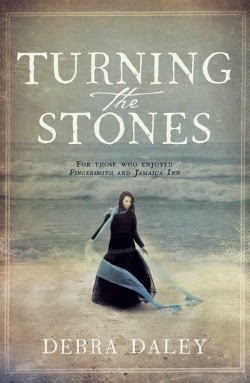
Turning the Stones by Debra Daley
Turning the Stones could so easily have become an overwrought melodrama with its much thwarted but beautiful young heroine, a family that will do anything for easy money, a blackguardly smuggler with a heart of gold, a witch-like curse maker and a particularly nasty villain. But somehow Debra Daley's latest novel rises above all this to provide a stonking-good read.
The reason for this is her writing style is brisk yet evocative, plus it has that slightly Irish lyricism that can be so appealing, all of which comes through the voice of Em, its much put-upon heroine. Em wakes up groggily in a man's Mayfair house, bloodstained and wearing only her shift, having lost her memory of how she got there. Soon she discovers that she is locked in and that the only other occupant of the bedroom has had his throat slashed.
This is 1766, and Em will surely hang if she is caught, so hastily dressing she jumps out the window and flees, hoping to buy herself a passage to France with the purse she has found on the dead man's floor. Her escape and eventual rescue on the ship of Irish smuggler, Captain McDonagh, makes for a nail-biting bit of storytelling, which could have come out of a Stevenson novel.
Interwoven with the escape story however is that of Em's background. It takes you back to Sedge Court, the Cheshire home of the Waterlands, a snootily gentile family desperate to cling to a fortune that is ebbing away as Mr Waterland takes up one hopeless scheme after another. His bitter yet beautiful wife soon realises that she needs to ensure a good marriage for her dull and graceless daughter Eliza. But Eliza is obviously overshadowed by smart, lovely Em, the foundling she has taken care of and raised as a daughter/companion for Eliza.
In a cruel twist of fate, Em is dumped into the servants quarters, and there is no more tutoring from the governess she has become attached to, just endless needlework and chores. Eliza's rakish brother, Johnny, has also noticed Em's obvious charms and makes plans to put them to good use. Everything is set on a collision course for the scene that Em wakes up to at the start of the book.
But we don't only have the two story threads of Em's past and her precarious future to keep track of, however. There's also the occasional visit to the house of Kitty Conneely in Connemara, who with her witch-like incantations - the turning the stones of the title - is determined to bring Nora's daughter home, whoever Nora might be. And it is no coincidence that the ship on board which Em has found a temporary respite is headed not for France, but disappointedly for Ireland.
Turning the Stones is a well-paced novel, full of dramatic scenes, nail-biting action and buried secrets, just as you'd expect, with shades of those early novels, Clarissa or Pamela (though I have read neither) by Samuel Richardson. The nicely turned writing balances out any tendency towards melodrama and its main character, Em, is superb - smart, witty and determined - as all good heroines should be. A surprisingly terrific read.
The reason for this is her writing style is brisk yet evocative, plus it has that slightly Irish lyricism that can be so appealing, all of which comes through the voice of Em, its much put-upon heroine. Em wakes up groggily in a man's Mayfair house, bloodstained and wearing only her shift, having lost her memory of how she got there. Soon she discovers that she is locked in and that the only other occupant of the bedroom has had his throat slashed.
This is 1766, and Em will surely hang if she is caught, so hastily dressing she jumps out the window and flees, hoping to buy herself a passage to France with the purse she has found on the dead man's floor. Her escape and eventual rescue on the ship of Irish smuggler, Captain McDonagh, makes for a nail-biting bit of storytelling, which could have come out of a Stevenson novel.
Interwoven with the escape story however is that of Em's background. It takes you back to Sedge Court, the Cheshire home of the Waterlands, a snootily gentile family desperate to cling to a fortune that is ebbing away as Mr Waterland takes up one hopeless scheme after another. His bitter yet beautiful wife soon realises that she needs to ensure a good marriage for her dull and graceless daughter Eliza. But Eliza is obviously overshadowed by smart, lovely Em, the foundling she has taken care of and raised as a daughter/companion for Eliza.
In a cruel twist of fate, Em is dumped into the servants quarters, and there is no more tutoring from the governess she has become attached to, just endless needlework and chores. Eliza's rakish brother, Johnny, has also noticed Em's obvious charms and makes plans to put them to good use. Everything is set on a collision course for the scene that Em wakes up to at the start of the book.
But we don't only have the two story threads of Em's past and her precarious future to keep track of, however. There's also the occasional visit to the house of Kitty Conneely in Connemara, who with her witch-like incantations - the turning the stones of the title - is determined to bring Nora's daughter home, whoever Nora might be. And it is no coincidence that the ship on board which Em has found a temporary respite is headed not for France, but disappointedly for Ireland.
Turning the Stones is a well-paced novel, full of dramatic scenes, nail-biting action and buried secrets, just as you'd expect, with shades of those early novels, Clarissa or Pamela (though I have read neither) by Samuel Richardson. The nicely turned writing balances out any tendency towards melodrama and its main character, Em, is superb - smart, witty and determined - as all good heroines should be. A surprisingly terrific read.
Saturday, 30 August 2014
Sidney Chambers and the Problem of Evil by James Runcie
It takes a fair amount of confidence to tackle a plot involving a serial killer who targets priests within the confines of a short story. This may be the reason there are only four stories in the latest book of Grantchester Chronicles, so that Sidney can get to grips with some meatier cases. As the title suggests, evil, and quite a lot besides, lurks in Sydney's thoughts as he becomes caught up in the first case, which has someone bumping off the local vicars. It all begins when a pair of dead doves is left on Sidney's doorstep. Soon after, the first vicar is killed, suffocated, and a claw-like symbol carved on his chest. Quite a grim beginning.
We have a dark and evil criminal for the first story, but there is still plenty of Sidney's episcopal ramblings of thought and quips from housekeeper Mrs Maguire, as well as the joys of Sidney's marriage to Hildegarde to lighten things up a bit. It's a pity Sidney's new domestic arrangements mean Mrs Maguire has to find employment elsewhere, because I always enjoyed her way of putting Sidney and his curate in their place.
The next story has a painting stolen in broad daylight from the Fitzwilliam Museum - a Sickert, showing a circus performer, and not the most valuable piece in the museum by a long stretch. Or does it have a particular value to the thief? And did the briefly naked French girl singing through the gallery have a connection with the heist?
This story is a bit more fun, with Sidney catching up with his old gal pal, posh Amanda, the art expert, and a trip across the channel with his backgammon buddy, Inspector Keating. It's amazing Keating is such a successful police officer, since he is often so bereft of clues, he frequently needs to call on Sidney to worm secrets out of witnesses with his cosy priestly manner.
The third story has the unlikely scenario of Sidney, along with his ageing dog Dickens, taking the part of the vicar in a film version of The Nine Tailors, one of Dorothy L Sayers more memorable whodunits. An army chum of Sidney's is the director, and of course there is plenty of off-set shenanigans plus a murder made out to seem an accident. This murder is particularly cunning, with a method I have never come across in my many years of mystery novel reading.
The fourth story is a bit shorter, and is a Christmas story involving the theft of a newborn baby, which gives Sidney many opportunities to ponder the birth of Jesus and miracle of new life. He'll follow his instincts and be more than usually sensitive to wrap this one up, while at home change is also afoot.
The Problem of Evil offers a collection of cosy mysteries, full of gentle wisdom and humour, with a background setting of early-sixties Britain. The Beatles are on the radio, the Cold War is in full swing, and there's loads of Cambridge atmosphere. I particularly like the pub where Sidney and Keating play backgammon and can only imagine what fun the people turning it all into a new television series will have. It is sure to look gorgeous.
Monday, 25 August 2014
The Luminaries by Eleanor Catton
'Tis done! I have turned the last page of The Luminaries, one of the larger novels I have read in some time, a book which put me in mind of Dickens, with its varied cast of characters, atmospheric setting and complex plotting.The story begins when Walter Moody, a young man lately of Scotland, arrives in Hokitika to chance his luck on the goldfields. He steps into a hotel lounge, and finds himself in the midst of a group of twelve men from all walks of life who have gathered to discuss the death of one man, the disappearance of another and the possible attempted murder of a prostitute. There is a large amount of gold involved as well as scullduggery, fraud and revenge.
It is late January, 1866, and the reader might be forgiven for imagining we are in the northern hemisphere as the weather is wild and wet, and miserable. But actually this is summer. For we are on the West Coast of the South Island of New Zealand, in a town just starting to flourish because of the gold rush, a frontier town with a treacherous bar where ships regularly founder and lives perish.
Each character: the shipping merchant, Balfour, who is worried about a missing chest - the bank clerk, Frost, who has frittered away the commission on the sale of a deceased estate that perhaps shouldn't have been sold; the chemist, Pritchard, who has probably imported the opium that may have been involved in the crimes discussed; to name but three - has a story to tell that will become one part of the jigsaw that will produce a picture of what happened.
And this picture takes time to describe, so the reader must sit back and be patient, like Walter Moody has to, and let the story be told. This accounts for the first three hundred and sixty odd pages. Each chapter has one of those little summaries that begins "In which ..." rather like you might find in a Victorian novel, and this is a big help in case you lose your way. With such a large cast of characters, this can easily happen.
During the next chunk of the book, the reader finally gets swept along by the events that happen next, and the action really picks up with a court case and retribution to follow. The last chunk of the book winds back to the beginning with short abrupt chapters, in which the "In which" intros are often longer than the text that follows, and the story oddly enough seems to end quite well, even though we are nearer the beginning.
The Luminaries is wonderfully written, recreating the West Coast gold rush and the odd types that might well have turned up there when there was nothing left to lose. With its rich prose wrought with care, engaging characters and a few decent nasty ones, and with its many layers - I didn't even get started on working out the significance of the astrology references - it is the kind of book you can happily read again and again - each reading offering up new riches. I wouldn't like to say if it was the best book on last year's Man Booker shortlist, but I for one was certainly not disappointed.
Friday, 8 August 2014
Fallout by Sadie Jones
Sadie Jones has a talent for recreating a particular time and place - previously Cyprus in the 1950s, as well as post war Britain - and giving each book an authentic feel. Add some well-rounded characters and a tense plot and her books are hard to put down. Fallout, her latest, keeps up the trend with a story about four talented young people in the world of theatrical London in the 1970s.
Luke, aka Lucasz and Lucas (his father is Polish and his mother, French), grows up in a dead-end Lincolnshire town, smart enough for Oxbridge, but reluctant to leave his needy parents - his mother lives in a mental asylum nearby, where he is a frequent visitor and never gives up on her, unlike his father who drowns his sorrows in drink and leaves all the cooking and household chores to Luke.
Quietly Luke fills notebooks with his scribblings, collects pop music - Dylan earns his undying respect - and reads plays. He thinks he'll go on working in the paper factory as a clerk until he bumps into Leigh and Paul, just up from London and lost, looking for a local playwright. Leigh and Paul are theatre people, and because it is raining, Luke jumps into Leigh's mini, the better to direct them to the rough pub they are looking for. The three strike up a friendship, and Luke sees kindred spirits, unlike anyone else he has ever met before.
The encounter is enough to jolt Luke out of his dull Lincolnshire routine. He throws in his job, packs his typewriter, heads for London and with nowhere to stay, looks Paul up in the phonebook.
Meanwhile, Nina is the fatherless daughter of a failed actress, brought up by a dully sensible aunt. When she turns fifteen she decides her life must include acting and living in London, where she turns up on her mother's doorstep. She leaves an aunt who loves her but can't show her any affection for a narcissistic mother who is controlling and leaves Nina no room for friendships or for being herself. Mummy particularly dominates any attempts Nina has with relationships.
Nina is very damaged, has little confidence but develops that fragile look that suits particular roles. Leigh is also damaged by her father's infidelity which destroyed her childhood, but copes by developing a tough outer shell that doesn't easily let anyone else in. Only Paul has had a happy and boringly ordinary childhood, except that his love for the theatre doesn't sit well with his father's more pragmatic ambitions for his son.
Luke enjoys his friendship with Paul and Leigh, but avoids any deeper relationships, having numerous flings with the young actresses he meets. He believes his mother's mental illness stands in the way of anything deeper. When he meets Nina, all of this is turned on its head.
With intense and talented characters like these and the setting of 70s London where all the old rules are fast disappearing, there is plenty of scope for drama and character development. Ultimately this is a story about creative ambitions, as well as friendship and love. This is a very intense novel, almost claustrophobic, and a gripping read - not my favourite by Sadie Jones, but still well worth a look.
Luke, aka Lucasz and Lucas (his father is Polish and his mother, French), grows up in a dead-end Lincolnshire town, smart enough for Oxbridge, but reluctant to leave his needy parents - his mother lives in a mental asylum nearby, where he is a frequent visitor and never gives up on her, unlike his father who drowns his sorrows in drink and leaves all the cooking and household chores to Luke.
Quietly Luke fills notebooks with his scribblings, collects pop music - Dylan earns his undying respect - and reads plays. He thinks he'll go on working in the paper factory as a clerk until he bumps into Leigh and Paul, just up from London and lost, looking for a local playwright. Leigh and Paul are theatre people, and because it is raining, Luke jumps into Leigh's mini, the better to direct them to the rough pub they are looking for. The three strike up a friendship, and Luke sees kindred spirits, unlike anyone else he has ever met before.
The encounter is enough to jolt Luke out of his dull Lincolnshire routine. He throws in his job, packs his typewriter, heads for London and with nowhere to stay, looks Paul up in the phonebook.
Meanwhile, Nina is the fatherless daughter of a failed actress, brought up by a dully sensible aunt. When she turns fifteen she decides her life must include acting and living in London, where she turns up on her mother's doorstep. She leaves an aunt who loves her but can't show her any affection for a narcissistic mother who is controlling and leaves Nina no room for friendships or for being herself. Mummy particularly dominates any attempts Nina has with relationships.
Nina is very damaged, has little confidence but develops that fragile look that suits particular roles. Leigh is also damaged by her father's infidelity which destroyed her childhood, but copes by developing a tough outer shell that doesn't easily let anyone else in. Only Paul has had a happy and boringly ordinary childhood, except that his love for the theatre doesn't sit well with his father's more pragmatic ambitions for his son.
Luke enjoys his friendship with Paul and Leigh, but avoids any deeper relationships, having numerous flings with the young actresses he meets. He believes his mother's mental illness stands in the way of anything deeper. When he meets Nina, all of this is turned on its head.
With intense and talented characters like these and the setting of 70s London where all the old rules are fast disappearing, there is plenty of scope for drama and character development. Ultimately this is a story about creative ambitions, as well as friendship and love. This is a very intense novel, almost claustrophobic, and a gripping read - not my favourite by Sadie Jones, but still well worth a look.
Tuesday, 29 July 2014
The Martian by Andy Weir
Andy Weir sure puts the 'science' into science fiction with his first book, The Martian. Hooking you in from the page one, the Martian of the title is quickly revealed as astronaut Mark Watney, who six days into a mission to Mars with five other astronauts, finds himself abandoned by his crew-mates and believed dead.
While the rest of the team escape what could have been a disastrous storm, Watney wakes up and begins the difficult task of saving himself in the short-term and making plans for his long-term survival. Another Mars mission is scheduled in four years' time and he's determined to be ready for it.
It is lucky that Mark is a trained botanist and that NASA thought that the crew would like some real potatoes to enjoy for Thanksgiving. Using a mixture of Mars dust, faecal matter and lots of water - he figures out a way to produce this in abundance - plus the potatoes, Mark builds a mini market garden inside the Hab, the dome that was to house him and his colleagues for a month.
The science gets a lot more complicated than that as he figures out how to contact NASA to let them know he is alive - though a smart young scientist had spotted activity already when watching some satellite images. He also has to figure out how to get himself several hundred kilometres from the Hab to the site of the next mission using an exploration vehicle which has been designed for short trips only. There are lots of technical details which I did my best to keep up with, and for someone who doesn't really know a lot about chemistry and physics (I could kind of keep up with the botany), it made for oddly exhilarating reading.
But Weir doesn't just throw a lot of science at the reader. He knows about how to keep the plot boiling along as Watney encounters numerous setbacks and NASA breaks rules and argues about what to do and somehow his old crew-mates come on board the story as well. And you can imagine how they must be feeling.
Though the star of the show is really Mark. He is a terrific character: funny as well as clever, determined and vigorous. There are plenty of comic touches, including the seventies music and old tv series that Captain Lewis thought to bring along and which Mark resorts to for the sake of something to break the tedium of his aloneness.
The overall effect of The Martian is a tribute to human inventiveness and the will of people all over the world to help out someone in trouble. It is also a bit like watching a cross between Kerbil Space Programme and Mythbusters. Not many writers could pull off a book like this and make it work. And it's not surprising that Ridley Scott has plans to turn the novel into a movie starring Matt Damon. I can't wait!
While the rest of the team escape what could have been a disastrous storm, Watney wakes up and begins the difficult task of saving himself in the short-term and making plans for his long-term survival. Another Mars mission is scheduled in four years' time and he's determined to be ready for it.
It is lucky that Mark is a trained botanist and that NASA thought that the crew would like some real potatoes to enjoy for Thanksgiving. Using a mixture of Mars dust, faecal matter and lots of water - he figures out a way to produce this in abundance - plus the potatoes, Mark builds a mini market garden inside the Hab, the dome that was to house him and his colleagues for a month.
The science gets a lot more complicated than that as he figures out how to contact NASA to let them know he is alive - though a smart young scientist had spotted activity already when watching some satellite images. He also has to figure out how to get himself several hundred kilometres from the Hab to the site of the next mission using an exploration vehicle which has been designed for short trips only. There are lots of technical details which I did my best to keep up with, and for someone who doesn't really know a lot about chemistry and physics (I could kind of keep up with the botany), it made for oddly exhilarating reading.
But Weir doesn't just throw a lot of science at the reader. He knows about how to keep the plot boiling along as Watney encounters numerous setbacks and NASA breaks rules and argues about what to do and somehow his old crew-mates come on board the story as well. And you can imagine how they must be feeling.
Though the star of the show is really Mark. He is a terrific character: funny as well as clever, determined and vigorous. There are plenty of comic touches, including the seventies music and old tv series that Captain Lewis thought to bring along and which Mark resorts to for the sake of something to break the tedium of his aloneness.
The overall effect of The Martian is a tribute to human inventiveness and the will of people all over the world to help out someone in trouble. It is also a bit like watching a cross between Kerbil Space Programme and Mythbusters. Not many writers could pull off a book like this and make it work. And it's not surprising that Ridley Scott has plans to turn the novel into a movie starring Matt Damon. I can't wait!
Thursday, 24 July 2014
The Language of Others by Clare Morrall
The Language of Others is the story of Jessica Fontaine, tracing her life from her childhood at Audlands Hall - the crumbling mansion her biscuit baron father bought to please her mother - through to her present day struggles with her grown-up son and her estranged husband.As a child Jessica's mother found her daughter unfathomable, possibly even retarded, unlike her sociable and attractive younger sister, Harriet. While her mother organised treasure hunts and parties and Harriet ran about the estate with their cousins, Jess would sit at an upstairs window reading or skating down the long gallery. Until she discovered music.
Jess is in fact smarter than she looks, and takes to playing the piano with a huge amount of commitment, enough to get herself into music school where she meets Andrew. She falls in love with Andrew the moment she first sees him, playing the violin. Andrew has a bucketload of talent but lacks the emotional maturity to use it. He resents his pushy mother for the path his life has taken and all the hours he spent practising as a child. Clearly, both have mother issues.
The story weaves in threads from Jessica's growing up and the early years of their marriage with her present-day life, working at a library part-time and playing piano duets to small audiences with her good friend, Mary. At home Jess's twenty-three year old son, Joel, still expects his mother to house and cook for him in spite of Joel's success in the computer gaming industry. To Jess's knowledge, Joel has no friends or ever had a girlfriend, and this worries her.
But her peace is completely shattered when Andrew gets in touch after seven years of no communication. Andrew has always been difficult, and refusing to play his violin for years, has never settled to any particular career path.
How Jessica comes to understand her son and Andrew while she is coerced into considering events from the past is the main thrust of the story. There is a lot of detail of a musical nature and Morrall recreates the house of Audlands with a finely imagined pen. This is a quiet story, that nevertheless builds to a dramatic finish, as friends and family come together one last time for a final barn dance at Audlands Hall.
But really this is a novel about self-awareness and how when you understand yourself, it puts into perspective your interactions with other people. Like previous books I've read by this author, she has created some unusual characters, who nevertheless engage the reader's sympathy and are carefully drawn. What stands out for me is the wisdom present in Morrall's novels, which though pleasurable, also leave you feeling enriched. What more could you ask for?
Subscribe to:
Posts (Atom)