Saturday, 31 October 2015

State of Wonder by Ann Patchett

State of Wonder is the story of Marina, a research scientist for the pharmaceutical company, Vogel, and it begins with the arrival of an aerogram letter. Her boss and secret lover, Mr Fox, shows her the letter which brings the news that her colleague and friend, Anders Eckman has died of fever in the Amazonian jungle. Anders had been sent to find out about the progress of a research project to develop a new fertility drug that would give older women the chance to have children.
    The project is headed by maverick scientist, Dr Annick Swenson, who years ago had been Marina's head surgeon in the obstetrics ward where Marina had made the terrible error that ended her hospital career. Marina has very mixed feelings about Dr Swenson, and is therefore not too happy about being sent to Brazil, at the request of both Mr Fox and Anders' wife, to learn the details of her colleague's death.
    Dr Swenson has been incommunicado, partly because of the remote location of the Amazonian tributary where she is carrying out her field work, and because she doesn't want any interference from Vogel until she has finished. Years have passed with very little communication, and the location of Dr Swenson is in doubt, but there is at least an apartment in Manaus, supplied by Vogel, which is somewhere for Marina to start.
    Marina arrives in sweltering Manaus from a chilly Minnesota to find her luggage has gone to Madrid. She discovers a helpful taxi driver and a not so helpful Australian couple who live in Dr Swenson's apartment and guard her privacy. It will be weeks, possibly months, before she can expect Dr Swenson to return for supplies. When she eventually does, and Annick reluctantly agrees that Marina can tag along with her back to the site of her research, the story really gets going.
    Marina finds herself battling nightmares caused by the anti-malarial drugs, and losing more of her clothing, so that she is attired in the loose shifts worn by the tribal women who are pregnant for most of their lives thanks to the addictive tree bark they nibble. She has to put up with Dr Swenson's unsympathetic and disparaging comments, but slowly finds favour. Does Annick even remember Marina from their former work together?
    Then of course there are the dangers inherent in the Amazon, from giant anacondas, to the poison arrows fired by a nearby tribe, the terrible heat and the very real danger of getting lost. Marina is a reluctant heroine, which makes her interesting and the situations she finds herself in are described with a dry humour.
    Patchett doesn't have to preach about the dangers of western interference on an endangered way of life, or the greed for pharmaceutical solutions to western problems, minor hiccups compared to those experienced by Amazonian people. Her story speaks for itself, but it does so with plenty of wit, action and many surprising revelations. It's a terrific read, and I was only sorry it had to end so soon. Happily there are other well-regarded novels by this author to enjoy, including Bel Canto which won an Orange Prize and which is also set in South America.
 

Thursday, 22 October 2015

Life Class by Pat Barker

With the release of Noonday, I thought it was about time I caught up with the first title in Pat Barker's second war trilogy, Life Class. It follows the story of talented artist, Elinor Brooke, her friend Kit Neville, a daringly different painter who is making waves on the art scene, and art student, Paul Tarrant. Both young men are drawn to Elinor, but she is cooly stand-offish, leaving Paul to throw himself into an affair with Teresa, an artist model and friend of Elinor's.
    Paul is from the north and a less genteel background, though his savvy grandmother was able to fund his schooling and has left him enough money to study art. This is where we find him, at London's Slade art school suffering under the critical eye of life-class teacher, Henry Tonks. Paul has a few good techniques up his sleeve, but his appreciation of human anatomy is hopeless and Tonks wonders why he is wasting his time there.
    It is the glorious summer of 1914, but the clouds of war are on the horizon. Dissatisfied with their lives for various reasons both Kit and Paul are desperate to see some action and eventually find themselves in France, Kit doing some war-reporting and Paul as an orderly in a field hospital. Barker really comes into her own recreating the smells, sounds and terrible sights as well as imagining the pain of wounded men being cared for in appalling conditions. There is never enough anaesthetic and the wounds horrific and barely imaginable.
    Before leaving London, Paul and Elinor had grown closer, and much of the latter part of the book consists of the letters they write to each other. Elinor refuses to have anything to do with the war effort, much to her parents' disgust, and carries on devoting her time to her painting. Paul is drawing too, but his subject matter is the terrible events he deals with day by day, which are surely unfit for public view. Both in their own ways are struggling with the role of art in the terrible human calamity that is war. There are glimpses of the Bloomsbury Group, described as a bunch of 'conchies', when Elinor becomes friends with Ottoline Morrell.
    Barker is a brilliant storyteller, her characters so distinct and intense. I love the way Elinor's point of view is loaded with the visual, and we see the world through her artist's eyes. Not that the language is ever wordy or overly descriptive, leaving the characters to get on with things. Which they do. The story builds, following Elinor's relationship with Paul on one hand, and as the danger of the front intensifies on the other. The question of whether relationships can survive a war that irrecoverably changes those caught up in it will surely be the subject of the next book in the series, Toby's Room, another to add to my 'must read' list.

Saturday, 17 October 2015

The Rosie Effect by Graeme Simsion

I was wondering what new problems Simsion would throw at his incredibly smart but socially inept hero, Don Tillman, in his sequel to the runaway hit, The Rosie Project. Don and Rosie, now married, are living in New York where Don has a post in the genetics department at Columbia University, and where Rosie has enrolled as a medical student. They have managed to find an apartment they can afford that meets Rosie's requirements for space and location and married life seems to be, well, rosy.
    When Rosie announces she is pregnant, this unplanned event throws all of Don's careful planning and timetabling into disarray and he reacts badly, causing a chain of events that could spell disaster. They are thrown out of their apartment, Don has to undertake a course of counselling at the risk of deportation and he hasn't figured a way to tell his Aussie mate, Gene, that Rosie is not happy about him staying with them during his sabbatical in New York.
    Don manages to keep all of the above secret from Rosie, yet as Rosie's pregnancy progresses, she seems to be drawing further and further away from him. Soon winning Rosie back is added to his list of challenges.
    That is pretty much the story in a nutshell, and not much more than what you get from reading the publisher's blurb. The book is peppered with a cast of memorable characters and this plus Don's knack for solving one problem with another gives the tale plenty of oomph. The housing problem for instance is solved by Don's promise to look after an aged English rock-star's on-tap beer by moving into his downstairs apartment - it smells a bit, and sometimes the Dead Kings get together for a practise session on the floor above but it is in every other way ideal.
    There are some hilarious scenes around Don's social worker, Lydia, who has decided he is unfit to be a father and sends him to anger management classes where he impresses the lads with his Aikido skills. To avoid adding stress to Rosie's condition, Don uses a daring piece of subterfuge to convince Lydia he is safe to stay in the US. Meanwhile Don's Dean requests his help monitoring a parenting study run by lesbians with a highly political agenda. Don's clinical intellectualism refuses to allow any leeway and he finds himself caught up in a new battle which will have crucial implications later on.
    The story builds up to a wonderful climax in the beery apartment, and Don will be torn in all kinds of directions as he tries to look after his friends while saving his marriage. His big-heartedness in this regard makes him yet again a brilliant and complex hero while the humour never lets up. Narrating the entire story in Don's singular voice takes some doing and Simsion pulls it off brilliantly. The novel is highly entertaining while rejoicing in the things that make us all unique individuals.

Tuesday, 13 October 2015

Instruments of Darkness by Imogen Robertson

Instruments of Darkness is the first novel in the Harriet Westerman/Gabriel Crowther mystery series and is set in the hot Sussex summer of 1780. The story really pulls you in because it introduces its sleuths in such an interesting way.
    Crowther makes the villagers nervous with his nocturnal habits and interest in anatomy, a pursuit that has led to a reputation for body snatching, which he may have had a hand in in the past. He is unhappy to be woken from his sleep by the well-to-do resident of Caveley Park and as a rule doesn't allow visitors. But the note she has slipped the maid is compelling: 'I have found a body on my land. His throat has been cut.' How can he resist?
    So begins a thrilling historical mystery at the core of which are some dark secrets at Thornleigh Hall, the seat of the Earl of Sussex. The current earl is bedridden and unable to speak following a stroke. He has a reputation as a cruel master who has recently married a dancer, flouting the laws of polite society. There is a cloud over his past, in particular regarding the death of a young girl, while his first wife also died in suspicious circumstances.
    The heir to the earldom, Alexander Thornleigh has abandoned his family, marrying for love and hasn't been heard of in ten years; his younger brother, Hugh, battle scarred from the American War of Independence, is quietly drinking himself to an early grave. After examining the body, a man in his thirties, Harriet sends for Hugh, fearing the victim may be his long lost brother.
    Two clues are found on the body - a ring bearing the Thornleigh crest and a scrap of paper torn from the man's fist. Hugh is not a pleasant man and is prickly with Harriet. A year or so before he'd been a welcome guest at Caveley Park, and there had been hopes for a match with Harriet's younger sister, Rachel. But something has changed Hugh, and Harriet fears a kind of evil lurking at the hall. If she is right, Rachel has had a lucky escape.
    The storyline cuts to London and the music shop of one Alexander Adams. He's a widower with two young children and for some reason he cannot find the old ring he has sometimes allowed little Jonathan to play with. In the background London is besieged by anti-Catholic riots, a situation which creates a memorable chase scene towards the end of the book.
    Robertson has started her series off with an excellent debut novel, full of intrigue, family secrets, evil malefactors and a growing body count. There's also budding romance among the minor characters and an interesting historical context. Best of all are the two main characters: the determined, outspoken Harriet, the doggedly anti-social and clever Crowther who has his own shadowy past. Together they make an entertaining sleuthing couple.
    If I have a problem with the book, it is that the copy-editing lets it down at times, though I noticed fewer gaffs as the story progressed, probably because I was so swept along by the plot. I shall certainly be happy to return to more Westerman and Crowther mysteries, for this is a classic ripping yarn.

Thursday, 8 October 2015

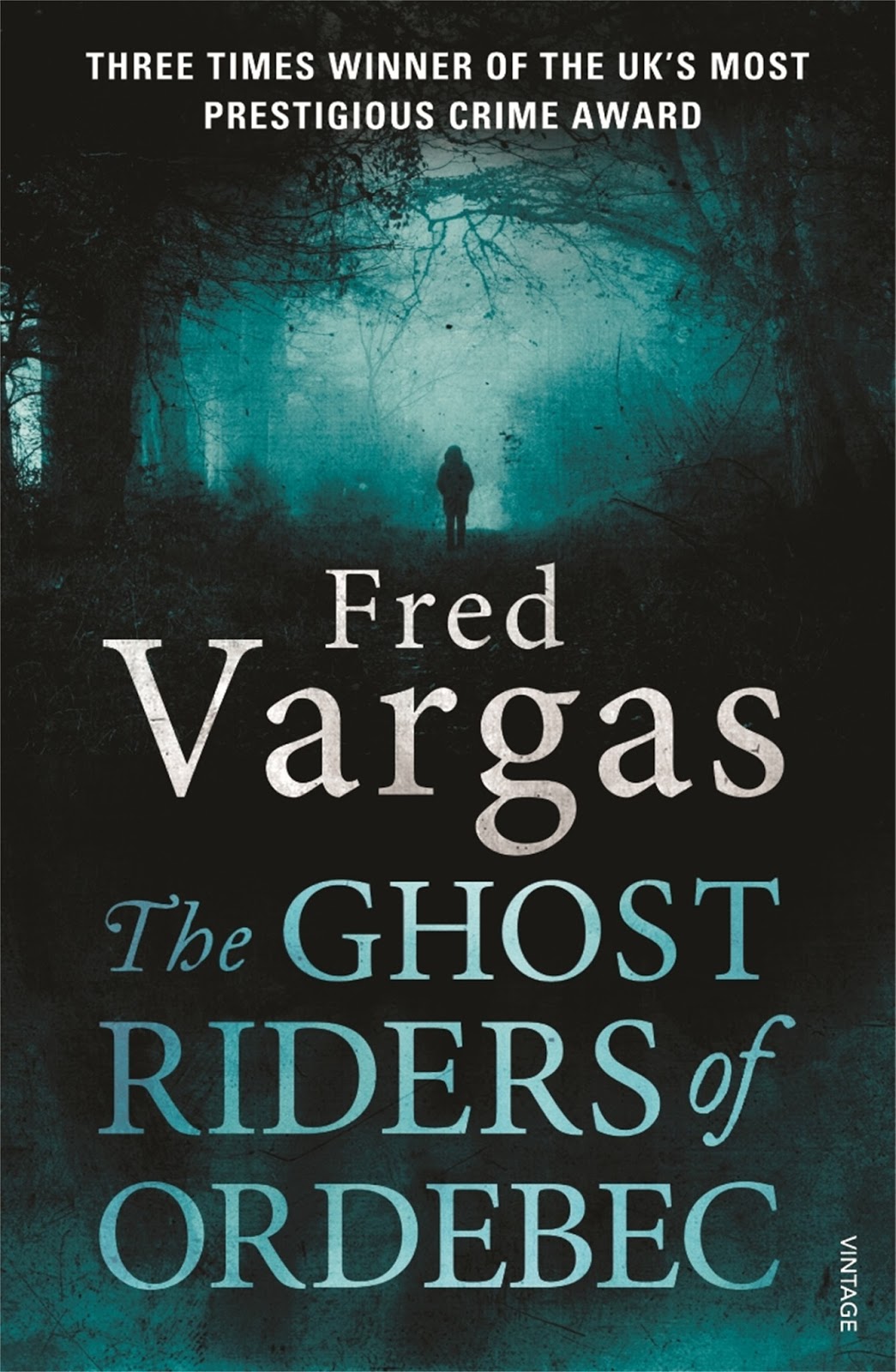
The Ghost Riders of Ordebec by Fred Vargas

Vargas throws four perplexing mysteries in not so many more pages in the opening chapters of her most recent Commissaire Adamsberg novel. He quickly solves the cause of death of an old woman who had apparently died in her sleep, but a trail of breadcrumbs leads him to suspect her husband of foul play.
    Soon after that, he rescues a pigeon, its legs tied together so that it cannot feed itself and looks likely to die. Adamsberg swears he will bring the perpetrator of this petty crime to justice, and takes the bird to Lieutenant Retancourt, his Amazonian subordinate - if she can't cure the bird no one can.
    Pacing the pavement distractedly and looking out of place on the streets of Paris, he meets an elderly woman who is too nervous to enter the police department doors. Eventually this Mme Vendermot reveals her peculiar story - that her daughter has seen the Ghost Riders of Ordebec and among them were four doomed men who live in her Normandy town, the first of whom has already disappeared. The local police take her for a madwoman and will not listen, but Adamsberg is fascinated.
    If only he hasn't been suddenly called off to investigate the murder of prominent businessman Antoine Clermont-Brasseur, his corpse found in his burnt-out car. The suspicion falls immediately on Momo, a serial arsonist whose petrol soaked sneakers are found on searching his home. But there are others who might want Clermont-Brasseur dead - his two sons are reportedly dissatisfied with his management of the family business and want to take over, yet torching an old man in his car seems a fearful way to go about it.
    Momo swears his innocence and Adamsberg, who has a knack for being able to detect if someone is lying, believes him. He masterminds a way for Momo to escape and to allow him to investigate the Ordebec mystery at the same time. His twenty-something son, Zerk, whom he has only come to know in recent months, becomes Momo's caretaker, bringing with them the rescued pigeon, hiding out in the house of the first of the Ordebec victims, a conveniently secluded cottage.
   Adamsberg installs himself in the home of another victim, the elderly Leone, felled by a blow to the head and now lying in hospital, unlikely to survive. What was it that Leone knew? He brings with him Lte Veyranc, recently returned to duty and spouting Alexandrine verse as is his way. He'll need the help of Commandant Danglard as well, useful as always for his extensive recollection of facts and fine taste in wine. He and Veyranc hate each other, and Vargas invents a clever scene to create a hilarious reconciliation.
    There is a huge cast of curious characters, in particular the Vendermot family - the son Hippolyte who speaks whole sentences backwards, his famously busty sister, Lina, who can understand him, the younger brother Antonin who thinks his bones are made of clay and the brother, Martin, who concocts nourishing meals out of insects. Adamsberg must work with Capitaine Emeri of the local gendarmerie, who has airs above his station on account of being descended from a famous military general.
    The story is both ridiculous and perfectly logical at the same time, enlivened by the way the characters, particularly those on Adamsberg's team play off each other. The Ghost Riders of Ordebec is quirky, original and such good fun and, best of all, the kind of escapism that manages to be intelligent at the same time. Not surprisingly it has won for the author her third CWA International Dagger award.

Saturday, 26 September 2015

The Information Officer by Mark Mills

You could easily pass off The Information Officer as just another pacy World War Two thriller. It has all the standard requirements. First off we have a young, intelligent investigator in the form of Max Chadwick. Max's step-mother has supposedly got him a cushy number for the duration, handling press releases for the military on the isle of Malta. It's propaganda really, aimed at maintaining morale and good relations with the islanders. As it happens it hasn't turned out to be such a safe billet with Malta the target of an ongoing bombing campaign by the enemy, which only adds to the suspense.
    Next there's an evil malefactor at large - in this case a rapist/murderer is stalking sherry queens, the women who work in the bars in an area known as the Gut. His previous killings have looked like accidents, with nothing to suggest a connection between them. But the most recent girl has bled to death from a wound that could have been caused by ack-ack shrapnel, or was it made to look that way?
    Max's doctor friend, Freddie, is alarmed when the latest victim is found with vestiges of a submarine officer's uniform clutched in her hand, and calls in Max to investigate. With relations between the British forces and the Islanders fragile at best, Max will have to move swiftly to find the killer before the details leak out and cause even more resentment.
    And of course it wouldn't be your classic thriller without a love interest for the hero. Max has a couple of options here. First off there's Mitzi, stuck in a loveless marriage with Lionel, an officer in the submarine corps. Mitzi works tirelessly for a service sorting the affects of dead RAF personnel, packaging them up for their families and writing heartfelt letters to accompany them.
    Then there's Lilian, half Maltese and half English, who is as smart as she is beautiful. Her job as deputy editor of a local newspaper brings her in contact with Max and the two are good friends.
    Max zips around the island on his motorbike and his easy manner means he has many acquaintances, some of whom are suspects. Lionel is a possibility if only because he wears the right kind of uniform and taking him out of the equation would free up Mitzi for Max, or is this too obvious a plot twist? Questions also hover over Elliott, an American pilot, temporarily grounded after an accident.
    Meanwhile the reader is treated to snippets of the perpetrator's own story through his eyes which are chilling and fortunately brief. It is all fairly classic stuff except Mills is a better than average writer. He captures the snappy dialogue of servicemen desperately keeping chipper while the Germans give them more than they can possibly return. The characters and camaraderie are all vividly brought to life, while the plot builds up to a terrific showdown as history is made in the air above.
    But what I really enjoyed was the picture Mills creates of Malta - an island with a long tradition of being under siege. With its distinctive architecture, amazing harbours and sunny Mediterranean ambiance - it is as much of a character in the book as Max.


Friday, 18 September 2015

The Household Spirit by Tod Wodicka

The Household Spirit is a story about neighbours - two very different neighbours, each with a peculiar problem. Fifty-year-old Howie Jeffries lives next door to Emily Phane on Route 29 in New York State - two solitary houses adrift on a road on the way from somewhere to somewhere else and not in itself a destination.
    The Phanes and the Jeffries have never been neighbourly in all the thirty odd years Howie has lived there. His wife's baking was rebuffed when the Jeffries first moved in, and the Phanes' odd household, an elderly couple that didn't get on, and then old Peter Phane on his own bringing up his granddaughter, has long been a source of speculation.
    Howie's solitude is disturbed when Emily Phane returns from her studies in Boston to nurse her dying Peppy, and after his death is unable to return to her former life. Emily has a night-time affliction, a sleeping paralysis which brings her disturbing visions from which she is unable to wake.
    She drifts through her days, filling her house with plants, losing weight and looking unkempt. When Howie rescues her after she sets fire to her house, he finds he can help her with her problem, while Emily helps him with his.
    Born with a face described by his ex-wife as 'the last face on earth', Howie had learned early on that his smile could make children cry, the kind of face not uncommon on a Nazi war criminal. As a result he has always been extremely shy, living a quiet life doing shift work for the local water company. Divorced for twenty years and only in occasional contact with his ferocious artist daughter, he spends a lot of his spare time fishing and dreaming about the sailboat he will buy one day.
    This could seem a quirky feel-good novel about two awkward characters, but Widicka's lively dialogue and original storyline add a ton of drama. There's a cast of interesting characters: Peter Phane who was in his day a well-respected journalist and has a string of elderly girl-friends; Harriet Jeffries the daughter Howie accidentally took to a Maroon 5 concert; Ethan, Emily's sort-of Korean, but not really, boyfriend, a solid brick of a bloke who won't ever let her down. There are plenty more.
    Wodicka's prose adapts cleverly to capture his characters - the youngsters' tone is hip New York with interesting use of social media; Howie is so little used to talking to people he makes up his own idioms that sit oddly on the page by comparison. As he opens up to people, his conversation slowly becomes more natural.
   The story builds to a curious denouement in a snowed in New York City which can be read more than one way or perhaps it is just a little to clever for me. Anyway I recommend any reader to make up their own mind about the ending, which is like the novel as a whole, utterly original and thought-provoking.